
Why Patients Choose Fee-for-Service Neurological Care?

When your neurological symptoms need more time and attention than a short appointment allows.
Neurologic concerns often require more than a brief appointment. A pounding headache with a story that spans years. A seizure pattern that's changed. A diagnosis that's never quite explained everything. These cases don't resolve in fifteen minutes, and they don't always follow a straight line.
At Longevity Neurology Center, our concierge-style, out-of-network/Fee-for-Service Neurological care model exists for exactly this reason: it gives us the time, flexibility, and continuity to work through complexity properly, rather than around it.

Longer Visits — Enough Time
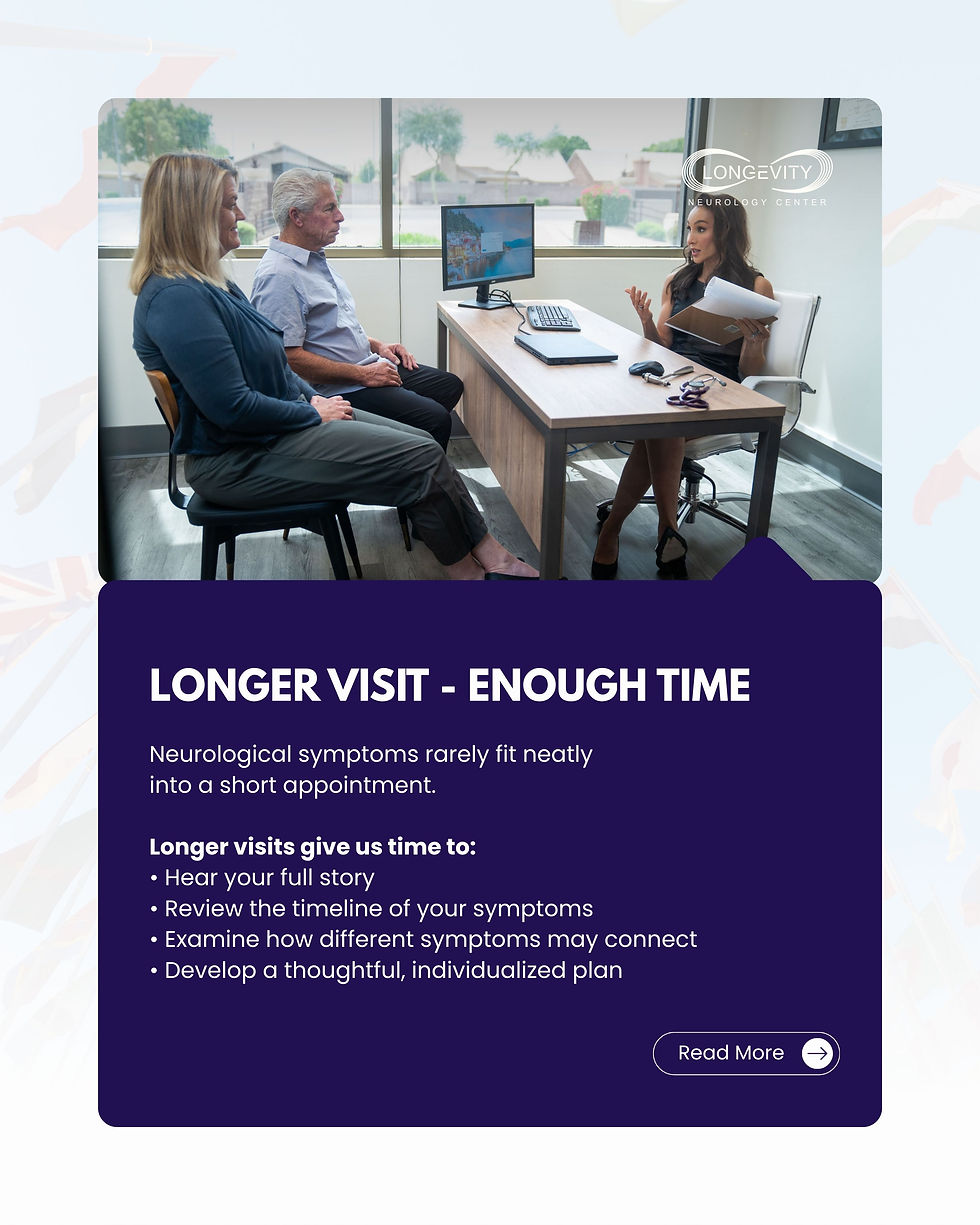
Neurological symptoms rarely fit neatly into a short appointment. Nationally, the average specialist office visit runs about 21 minutes, according to a long-running analysis of U.S. ambulatory care data — barely enough time to review a chart, let alone untangle a decade of symptoms. Longer visits give us time to:
Hear your full story
Review the timeline of your symptoms
Examine how different symptoms may connect
Develop a thoughtful, individualized plan
Your Full Story Matters
Bring your questions. Bring your timeline. Bring the records that help tell your story. We welcome patients with long symptom histories and complex concerns, and take the time to carefully connect the dots — something a traditional system, constrained by short visits, may not always have room for.

When Symptoms Suddenly Change
You shouldn't have to wait months when something important changes. Patients nationally wait an average of 50 days for a first neurology appointment, even with commercial insurance. Our model is built to offer flexible, faster access when patients experience:
Worsening headaches
Increased seizure activity
New or changing cognitive symptoms
A flare of neurological symptoms

The Value of Looking Deeper
In complex neurology, the original diagnosis may not always explain the full picture. A detailed history, careful examination, record review, imaging review, and appropriate testing can reveal possibilities that were previously overlooked.
This isn't unique to any one practice — research on rare and complex neurological conditions shows that patients often wait years for an accurate diagnosis, with average time-to-diagnosis estimated at 4.7 years, and roughly a quarter of patients waiting more than five. Time and a thorough diagnostic process are often the missing ingredients.
In just one month, a more comprehensive approach at Longevity Neurology Center helped us uncover several important diagnoses.

One Month of Looking Deeper: Patient Stories
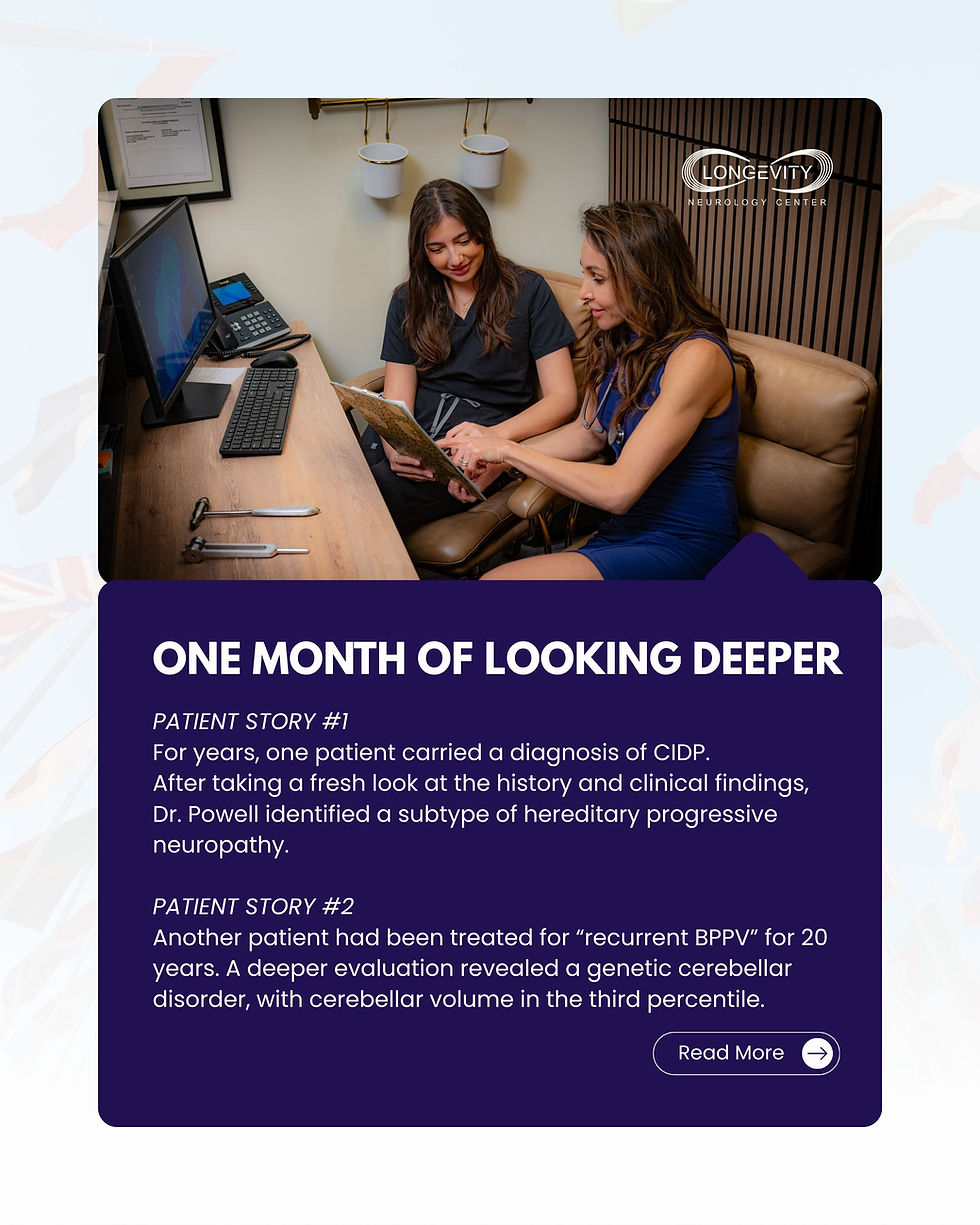
Patient Story #1 For years, one patient carried a diagnosis of CIDP. After taking a fresh look at the history and clinical findings, Dr. Powell identified a subtype of hereditary progressive neuropathy.
Patient Story #2 Another patient had been treated for "recurrent BPPV" for 20 years. A deeper evaluation revealed a genetic cerebellar disorder, with cerebellar volume in the third percentile.
Patient Story #3 A patient had lived with a multiple sclerosis diagnosis for two decades. Further investigation and genetic testing supported a different diagnosis: hereditary spastic paraparesis.
Patient Story #4 A young woman experienced dizziness, heart palpitations, and gastroparesis. Her symptoms had previously been attributed to anxiety. A comprehensive evaluation identified POTS and autonomic dysfunction, along with positive autoimmune markers that provided important clinical context.
(Patient details have been generalized to protect privacy. No names, ages, or identifying information are included.)

Why Fee-for-Service Neurological Care Model Matters
Not because they are bad docs — but because insurance-based practices often face significant time and scheduling constraints, making it difficult to fully investigate highly complex cases.
A fee-for-service model gives us the time and flexibility to focus on depth, continuity, and individualized care. We value patients who come in with long lists of issues and chronological symptoms — the kind of case that, in a traditional system, may have been overwhelming to fit into a standard appointment slot.

A Different Care Experience
Our concierge-style space is designed to help you feel comfortable and welcomed.
Bring your questions. Bring your symptom timeline. Bring the records you've collected for years. Your story is not "too much." It may contain the details we need to finally connect the dots.
Ready for a more thoughtful approach to your neurologic health? Contact us to learn more.

Frequently Asked Questions
What is fee-for-service neurology? Fee-for-service (also called direct-pay or out-of-network) neurology means the practice is not bound by insurance-dictated visit lengths or scheduling constraints. Patients pay directly for care, which allows the neurologist to offer longer visits, more frequent follow-ups, and greater flexibility in how much time a case requires.
How is concierge, out-of-network neurology different from insurance-based care? The clinical training is the same. The difference is time and access. Insurance-based practices often operate under significant scheduling constraints that limit visit length and follow-up frequency. A concierge, fee-for-service model removes those constraints, giving the physician more room to investigate complex or long-standing symptoms thoroughly.
How long does a neurology visit take at Longevity Neurology Center? Visits are structured around what the case actually needs rather than a fixed time slot, so they typically run longer than the national average specialist visit (about 21 minutes). This allows time to review a full symptom history, prior records and imaging, and develop an individualized plan.
What should I bring to my first appointment? Bring your questions, a timeline of your symptoms, and any records or imaging you've collected over the years — even if it feels like "too much." Long, detailed histories are exactly the kind of case this model is built to take on.
Can a long-standing diagnosis actually be wrong? Yes. In complex neurology, an original diagnosis doesn't always explain the full clinical picture. A fresh, detailed history combined with appropriate testing — including genetic testing where relevant — can sometimes reveal a different underlying condition, even after a diagnosis has stood for years.
What if my neurological symptoms suddenly get worse? Patients experiencing worsening headaches, increased seizure activity, new or changing cognitive symptoms, or another flare of neurological symptoms can be seen with more flexible, faster access than the roughly 50-day average wait time reported nationally for a first neurology appointment.
Bottom Line
Complex neurological cases need real time, not a rushed checklist. A fee-for-service, concierge model gives Dr. Powell and the team at Longevity Neurology Center the time, flexibility, and continuity to take long symptom histories seriously, investigate complex cases fully, and offer fast access when something changes — all inside a space built to make patients feel welcomed, not rushed.
Sources referenced:


Comments